Christopher Nolan’s Inception: The Oneiric Intruder and the Architecturalism of Space
By Andrew Young


Early in Christopher Nolan’s Inception (2010) Ariadne (Ellen Page), an architecture student, is given the task of designing a maze in two minutes that takes one minute to solve, a charge that finds itself repeated in the complex layering of space and time later in the film. Puzzles come to take on an important meaning in many of Nolan’s films (even the logo for his production company, Syncopy Films, is a large maze), but this is particularly the case in Inception.

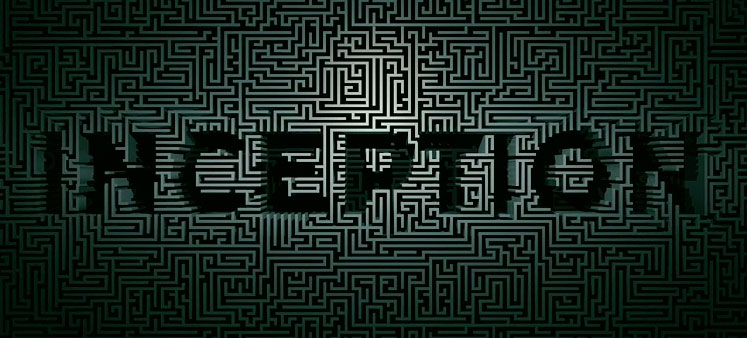
The maze motif in both the film and production company title. (Screen grabs)
As a filmmaker focused on minute details, with an analytic fervor that is difficult to understate, Nolan’s regimentation of the dream space is of interest. More to the point, the film argues for a construction of dream space that is far separate from the traditional oneirological systems of the Freudian reflection of the subconscious, or even more recent experimental theories such as Jie Zhang’s process of “continual activation.”1 Instead, dream space is constructed and overseen as a parallel effort between the dreamer, the “architect”, and, to some extent, what can be construed as the oneiric intruder (a process the film refers to as “shared dreaming”). This is, in essence, the central theme of Inception, in that the very experience of extraction, the encroachment into another’s dream, raises questions about the very nature of individual independence in a utopic/dystopic future that such a thing as “inception” could even be possible. Most importantly, though, the invocation of “the architect”, along with their created dream spaces, very much operates to expand our understanding of “built space” within architectural anthropology as it relates to filmic space.2
The film follows an intruder, a thief named Cobb (Leonardo DiCaprio), as he works to plant a thought into the mind of Robert Fischer (Cillian Murphy), the heir to a large corporate empire, at the behest of Saito (Ken Watanabe), the owner of a rival company. Of course, this is made all the more complex by the increasingly destructive incursions of Cobb’s deceased wife, Mal (Marion Cotillard), as a projection of his subconscious gone out of control. The architect’s role in the creation and cohesion of dream space is important in so far as that her subordinate relationship to the narrative ignores her larger importance to the film’s thematics. We primarily expect to see Ariadne as the primary figure of this process of creation, that of shared dreaming, and the emergence of Mal into that space raises serious questions about the actual independence of the dreamer, even within the complex interdependence of the shared dream.

Mal, along with Saito, intervenes in Cobb’s plans. (Screen grab)
As Cobb points out as he’s introducing Ariadne (and the audience) to the dream space, “We create and perceive our world simultaneously.” The role of the architect, then, is to design a space with an authenticity, but without experiential familiarity (as he warns her later not to design based on structures in the real world). As a result, the dream is an environment of specificity, in that it is required to feel real, as well as vagueness, as it cannot be pulled from “the real.” In this way, synthetic reverie emanates from a pre-constructed environment, but is still reliant upon the dreamer (as Cobb points out, “We bring the subject into that dream, and they fill it with their subconscious”).
In some ways, then, the role of the architect can operate as analogous to a database, “a physical supplement for man’s mind, and seeks to emulate his mind in its associative linking of items of information, and their retrieval as a result.”3 Like Vannevar Bush’s memex, a theoretical construct that, in 1945, presaged the World Wide Web, the architect, too, creates from a digital taxonomy of textures, structures, and space to create an interpretation of reality within the dream (much like a database of components). It does so, though, at the mercy of a collective knowledge, dependent upon the architect’s understanding of the created space, but also upon the dreamers themselves (as they will populate it). For example, Saito’s revelation that a rug within the dream is made from the wrong material is important because it isolates the agency of the dreamer within the constructed realm. But it is equally important in reinforcing the alien character of the dream space. This apartment is one of the few spaces in the film that is based on a “real” location, resulting in the failure of the extraction (just as Ariadne’s use of real architecture from her memory later results in her being attacked by Cobb’s subconscious). In such a way, dream space must necessarily be a composite of expected reality (it is not a land of complete unfamiliarity), but not of reality itself. Mal, then, operates through Cobb’s subconscious to search-and-destroy the “real”, an extension of Cobb’s own rejection of some just-out-of-reach reality.
Much of the film works to point at this unspecified “reality”, one that we are arguably given glimpses of, but that never quite appears as complete. A key indicator of this is Nolan’s utilization of spatio-temporal parallelism in the layered dream sequences. The rumbling of the pagoda mansion in reaction to explosions in Nash’s (Lukas Haas) dream space articulate a direct connection between space and time that is more complexly mirrored in later sequences of the movie.
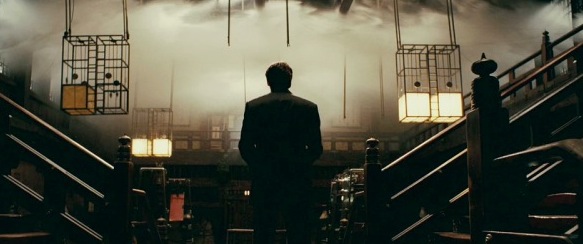

Cobb sees water pour through the pagoda windows (left), and he’s “kicked” back into “reality” (right).
(Screen grabs)
This correspondence of spatiality and temporality speaks to the manner by which the film problematizes and abstracts the more traditional theories of architectural anthropology. Nolan’s film identifies all aspects of the dream as “built forms”4 of environment, as they quite literally require an architect, implying that external spaces (both the snowy mountains and the parallel spaces alike) are part and parcel of an organic construct. In some sense, the architect operates outside of “bounded” space: though she must build a coherent reality, the design expands beyond the individual constructed levels, bleeding into one another. As a result, though the hotel is specifically designed in order to facilitate the “kick” so that all of Cobb’s team can wake up at the right time, the dream has been designed without taking into account the effect of unbounded parallel space (as the loss of gravity later in the film forces Arthur, played by Joseph Gordon-Levitt, to improvise). The selection of designed spaces also raises serious questions about the agency of the dreamer and control over their oneiric space.
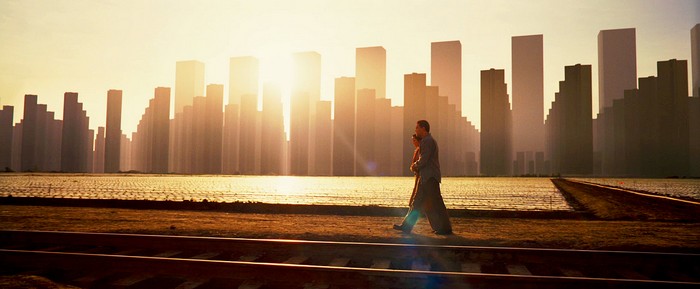
In truth, the interdependence between spatial environment and human behavior is nothing new; it is as old as Durkheim and the origins of social science itself.5 Nolan’s film, though, expresses a more direct expression of this dynamic through the explicatory nature of the setting itself. The literal or symbolic meaning of the spaces used in Fischer’s dream chain (the cityscape, hotel, mountain complex, and eventually Limbo) is unclear to some extent, though it certainly works to exude the increased layers of Fischer’s subconscious’ defense from the familiar and urban, to the remote mountain lair, and finally the complete abstraction of Limbo.
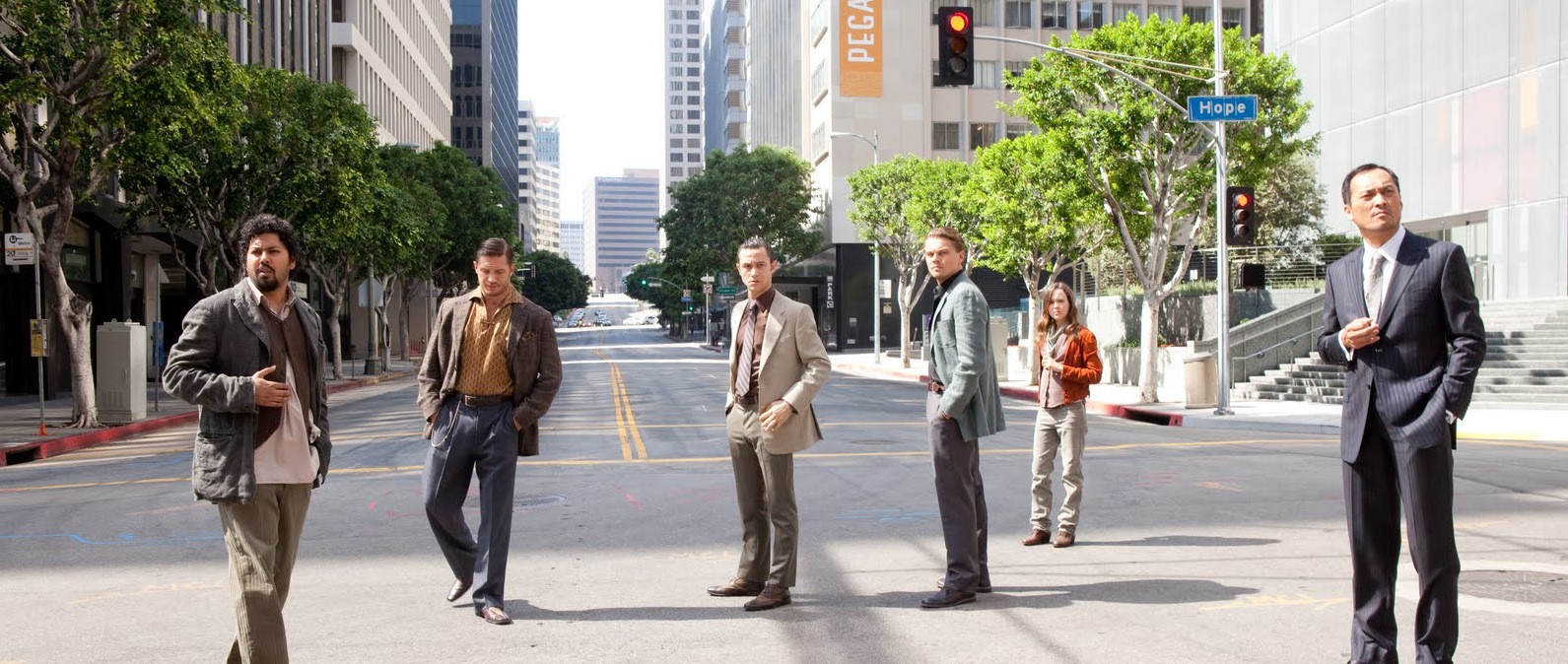
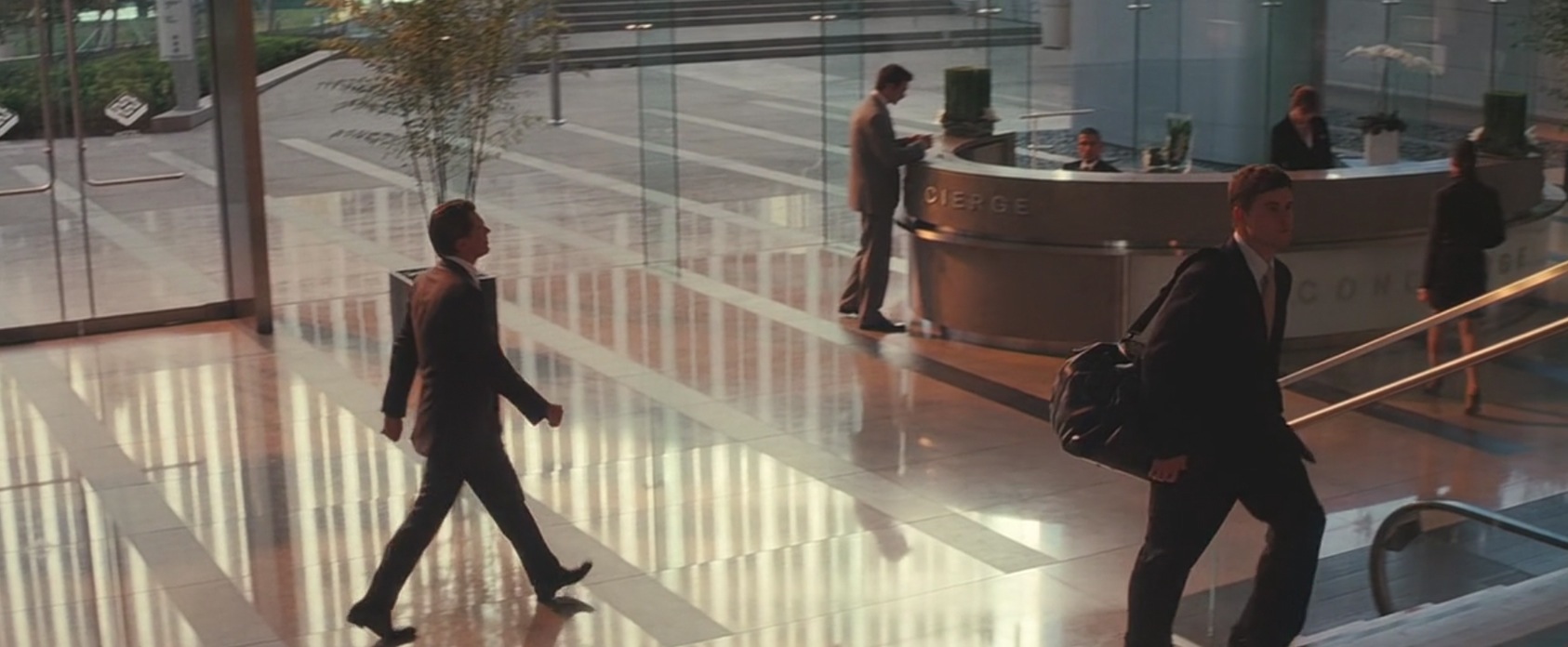

The various levels of the created dream space. (All promotional still, except bottom right screen grab)
What is interesting, though, is the way that the film plays with the implantation of memory beyond the “inception” of Fischer. The beginning of the film introduces Saito as an old man, having been stuck in Limbo, in the pagoda mansion. But this is not part of his memory; instead, he has chosen to return to this place (and as this is undeveloped dream space, he has theoretically built it from the memory of his earlier extraction experience). Is the very construction of oneiric space, then, not an act of “inception” in and of itself? Would this construction not be possible, then, using Jie Zhang’s theoretical framework that the constructed dream space acts as an intermediary in the transition between short and long term memory? To adapt architectural anthropology, it could be argued that this dream space operates similar to our understanding of the evolution of architecture, as Denise Lawrence and Setha Low have argued, “Such relationships are interactive, in that people both create, and find their behavior influenced by, the built environment.”6
In such a way, we must understand the film’s use of space as resultant of the particularity of its inhabitants. Though the architect is responsible for the delineation of regimented space, the different layers of the dream offer up parallel and related spheres of interactivity. The construction of these realms, along with their inhabitants (Mal included), comes to take on far more than the Freudian sum of their parts. Instead, space is defined by time, and time by space.
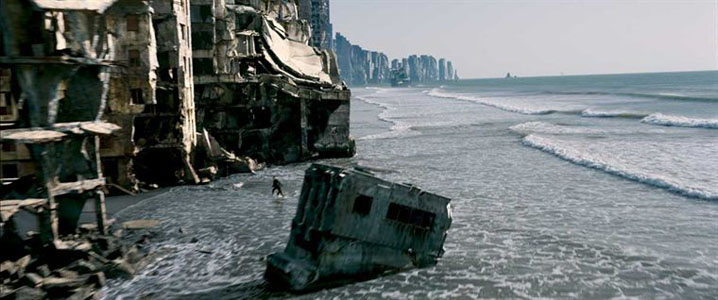
Wandering the wasteland of limbo. (Screen grab)
The oneiric intruder comes to take a role of far greater importance than simple bystander. Instead, the entire process of the dream becomes one of “inception” as well, extrapolating and interpolating thoughts and fears that the characters (assuming they “exist” to begin with) are already hiding. Nolan ties these tensions to spatial and temporal (and narrative) anchor points within the various levels of the dream, then works to unravel them in rapid succession. The result is a film constructed as a maze not so dissimilar from that which Ariadne is asked to build. Beginning with Saito’s discovery of the totem, and ending with the indelible image of it spinning, the film offers up one last possible passage of escape/entrapment for the audience, perhaps suggesting that the dream may have been ours all along.
NOTES
- Zhang’s arguments that dreams are a process of transitioning short-term memory into long-term memory is interesting, though problematic, and is thoroughly discussed in his, “Memory Process and the Function of Sleep,” Journal of Theoretics, Vol.6-6, December, 2004.
- There is a succinct overview of the issues of language and the diverging and converging perspectives that currently work in defining our understanding of space in Stephen C. Levinson’s “Language and Space,” Annual Review of Anthropology, Vol.25, 1996.
- Bush, Vannevar. Pieces of the Action. New York: Morrow, 1970. 190.
- Lawrence, Denise L. and Setha M. Low discuss these taxonomies in great detail in their work, “The Built Environment and Spatial Form,” Annual Review of Anthropology, Vol.19, 1990.
- Though it should be noted that these early formulations were not sufficiently exploratory of the role of material culture in this process.
- Lawrence, Denise L. and Setha M. Low. 454.

Author bio:
Andrew Young is a PhD Student in Cinema and Media Studies at the University of California, Los Angeles. He is co-author of the Chicano Studies Research Center report "Commercial Talk Radio and Hate Speech Social Networks.” His current research focuses on representations of violence and trauma in post-genocidal cultures, particularly reconciliatory discourse in Rwandan cultural production.

Christopher Nolan’s Inception: The Oneiric Intruder and the Architecturalism of Space by Andrew Young is licensed under a Creative Commons Attribution-NoDerivs 3.0 Unported License.