War Games at Home, Home Games at War: Geography and Military First-Person Shooting Games
By Diana M. Pozo


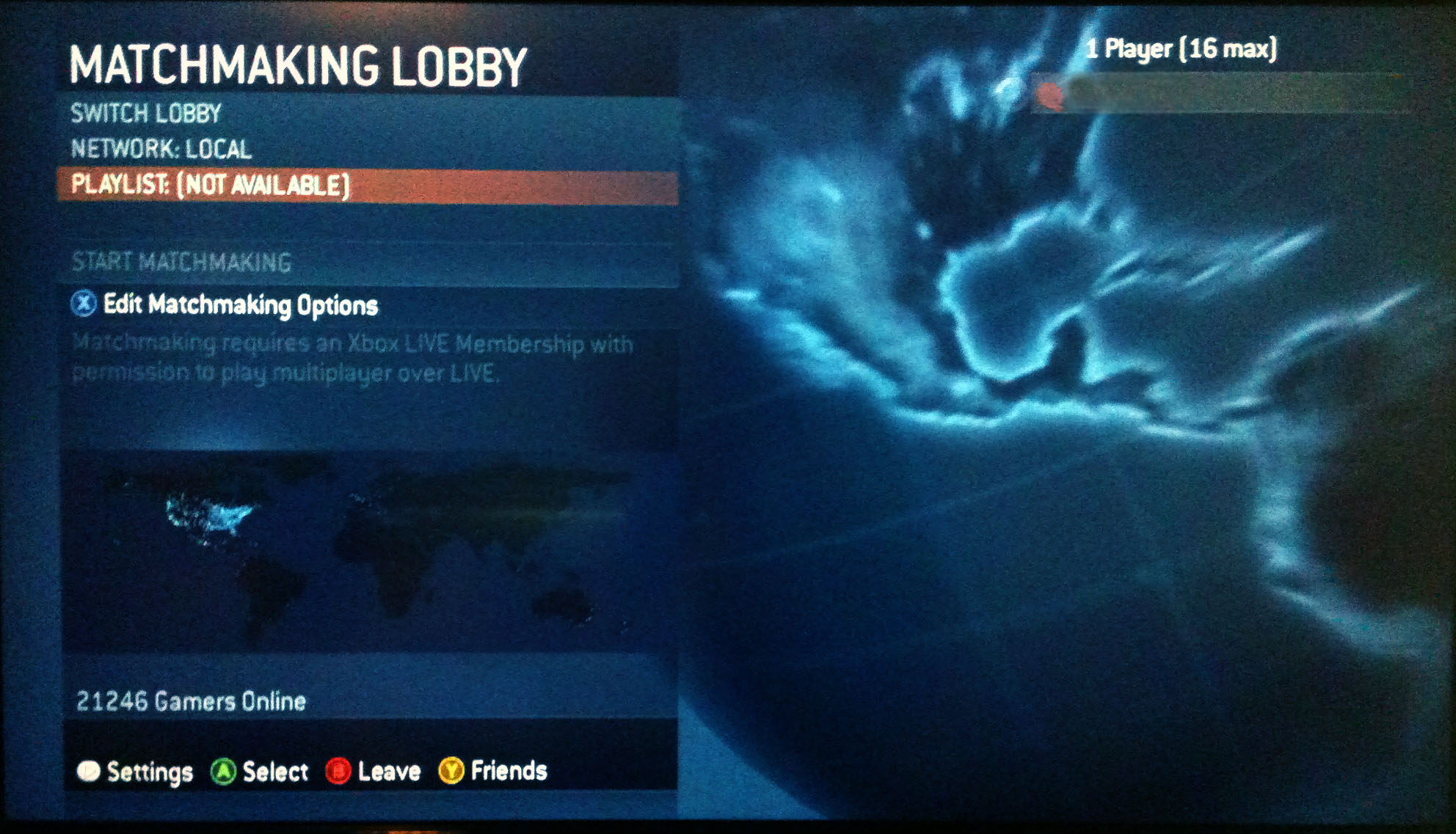
Halo 3 matchmaking screen on Xbox Live. Photo taken by author, 29 March 2011 [gamertag removed].
Log on to the multiplayer mode of Halo 3 (Bungie/Microsoft, 2007) on Xbox Live, and you will see a map of the world. An array of glowing dots marks the locations where gamers are supposedly connected, with a caption stating the total number of gamers online. A rotating globe filling most of the screen emphasizes the Xbox Live network's globality, even as the concentration of dots on the static map may reveal a local cluster of connected gamers at any given time. This matchmaking screen's emphasis on the global is typical of a certain conception of disembodied online travel, what Lisa Nakamura describes as the promise of a "'world without limits' where [the consumer] can possess an idealized mobility."1 The global imagery of Halo 3's matchmaking lobby suggests that a gamer on Xbox Live may be matched against gamers from all over the world. However, as of November 2010, Xbox Live is only available in 35 countries and territories, disproportionately including North American and European countries over those in Africa and Asia. Moreover, gamers' experience of the multiplayer mode of their favorite games is conditioned not only on their country's inclusion in Xbox Live coverage and their ability to pay the $60/year subscription fee. Multiplayer gaming also depends on extremely fast Internet connections, which are unequally available across the world, and the slightest amount of "lag" in the network can be the difference between game mastery and game failure. Thus, gamers in multiplayer gamespace do not engage in disembodied online travel as Halo 3's matchmaking lobby suggests. Rather they are highly affected by and, in some cases, aware of the geographical factors influencing their gameplay.
The relationship between video games and space is one of the major questions in video game theory. Johan Huizinga's foundational Homo Ludens describes the space of play as a "magic circle," a special designated space for play he calls "temporary worlds within the ordinary world, dedicated to the performance of an act apart."2 While the magic circle described by Huizinga may be a physical space (a basketball court, for example, or a game board), Katie Salen and Eric Zimmerman cite Bernard Suits's concept of the "lusory" or playful, attitude, to emphasize that what creates a space for play is both physical and mental.3 The concept of the magic circle imagines play as separated from the ordinary physical world and gamers' usual state of mind, but Huizinga also emphasizes the effort required to remain in the magic circle of gameplay. Any single player cheating, becoming a sore loser, leaving the space, or otherwise disrupting the game makes the mental-physical space of the game less magical, and therefore less enjoyable.
The intrusion of obstacles to gameplay associated with the outside world, like the interruption of a car driving by in a game of street hockey, disrupts gamers' enjoyment. However, these interruptions are often an inevitable and integral part of the game experience. In the case of online multiplayer gaming, gamers meet others, potentially from around the world, in computer rendered spaces. However, the geographic distance between gamers in the space sometimes intrudes on the space of gameplay. Similarly, gamers' physical locations while gaming may affect their experience of the space of the game. Thus, while gamers may experience a magic circle effect while playing video games, the magic circle is never completely separate from "the ordinary world."
This paper will examine the geography of virtual space as an intrusion of the ordinary world in "hard-core" commercial first-person shooting game franchises such as Halo, Call of Duty, and Medal of Honor, where hard-core games are defined, in opposition to "casual games," as top-selling console and/or PC game releases, often targeted at a young-adult male consumer. The fact that the hard-core games I have chosen are shooting games is not accidental, as hard-core games commonly feature fast-pacing, violent content, and relative inaccessibility to young children. Rather than focusing on the single-player "campaign" mode of these games, I examine first-person shooting games' multiplayer mode. Throughout, this paper discusses the ways that geography is an integral part of military first-person shooters, rather than seeing these games as portraying solely "virtual" spaces. Moreover, I will argue that gamers are aware of many of the ways in which virtual space is intertwined with physical space.
In the case of military-themed gaming, the real-world implications of players' actions in the gamespace has been particularly important, but media-effects arguments about video games provoking real-world violence and discussions of the uses of gaming as an advertising tool for the military position gamers primarily as receivers of video game messages. By focusing on gamers' knowledge of the ways in which video games are connected to physical geography, either through the geography of multiplayer networks and the Internet itself, or through the global circulation of video games as commodities (even to deployed American military abroad), I hope to complicate scholarly understandings of gamers' interaction with hard-core games — particularly military shooting games — to include gamers' awareness of their own geography, even as they interact in virtual spaces. This awareness of the physical implications of actions in video games challenges understandings of contemporary warfare. Terming the first and second gulf wars "video game" or "Nintendo" wars and accusing military of "video game-like" behavior implies that video games distance gamers from "real life," making them unaware of the physical implications of their actions. However, a greater understanding of the ways in which gamers are aware of geography, a quantity which has, sometimes problematically, been seen as quintessentially "physical," may allow scholars to better understand the terms of "video game" warfare, even as America's military becomes increasingly video game-like. In addition, the increasing interconnectedness of video games and the U.S. military at every stage of soldiers' experience further challenges the concept of video games as divorced from the "serious" or the "real."
This paper is divided according to two overlapping demographics of American gamers in the mid to late 2000s: civilians playing military-themed games on multiplayer networks, and deployed military personnel in Iraq or Afghanistan playing the same games on multiplayer local-area networks or playing the games' single-player campaign mode. At "home" in the U.S., I explore two fundamental discontinuities of gamespace — glitches and lag — that rupture the immersion of gamers in a seamless "war space." Lag, in particular, is extremely annoying to gamers because it disrupts hard-core gamers' experience of game mastery and underscores the fact that the possibility of game mastery is unequal due to the hierarchical structure of the Internet itself. At "war," I examine the ways in which American soldiers in Iraq and Afghanistan describe playing video games designed to represent their experiences. Rather than experiencing war-themed games as accurate representations of their experiences, American military personnel describe war-themed video games as a nostalgic contrast to the war spaces of soldiers' everyday lives, transporting them to a safe and comforting "home space," even as military uses of video games seem to contradict this point of view. Both of these understandings of military gaming, at "home" and at "war," complicate our understanding of the relationship between video games, physical space, the "real," and the U.S. military.
War Games at Home: Military First-Person Shooting Games and "Full 3D Space"
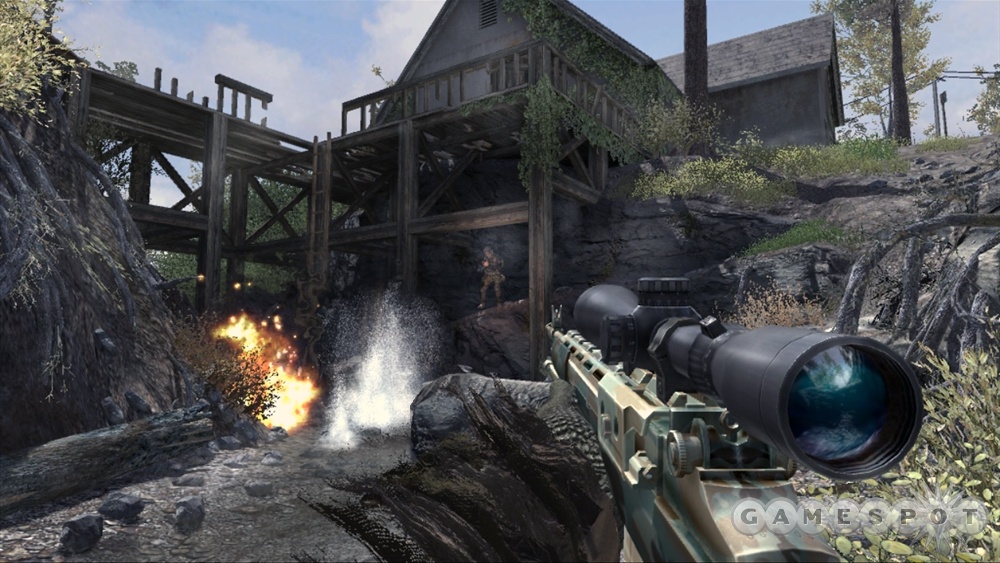
Above: "full 3D space" in Call of Duty: Modern Warfare 2
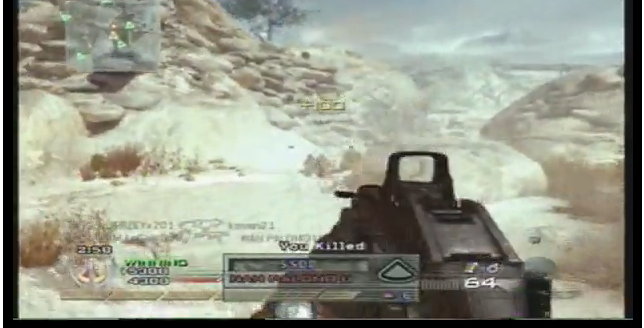
Below: Screenshot of multiplayer map "Afghan" in Call of Duty: Modern Warfare 2. A pop-up window in the bottom center tells the player the pseudonym of the player s/he has just killed. A symbol at the bottom left designates the "faction" this player is affiliated with in this multiplayer match. In this case, the player is playing as part of "OpFor," the fictional middle-eastern antagonists of the single-player mode.
Despite controversy over their representational content and their position within American military operations, military first-person shooting games are extremely financially successful. The newest releases in the military-themed franchise Call of Duty, Call of Duty: Modern Warfare 2 (Activision/Infinity Ward, 2009) and Call of Duty: Black Ops (Activision/Treyarch, 2010) each sold over 12 million copies for the Xbox 360 alone, with an additional 5-6 million sold on other platforms. Modern Warfare 2 and Black Ops both set records for fastest sales, with Black Ops on Xbox 360 and PlayStation 3 each selling 2 million units in their first week of release. The Hollywood Reporter even hailed Call of Duty: Black Ops as the "biggest selling video game in history in the U.S."4
As might be expected, first-person shooting games dramatizing global warfare from an American perspective are a particularly American craze. Over two thirds of sales for Call of Duty were within the Americas, and the top six fastest-selling games in the Americas are all in the first-person shooting format, including three entries from the futuristic Halo franchise.5 However, the popularity of the military first-person shooter format is not restricted to the United States. Journalist Ed Halter describes the enthusiasm of Middle Eastern youth for the military first-person shooting format, calling the trend "Islamogaming."6 Nick Dyer-Witheford and Grieg de Peuter write of Islamogaming in the context of the US Military training game turned civilian entertainment, Full Spectrum Warrior (Pandemic Studios/THQ, 2004), "What the [game designers] may not have foreseen is that the United States' insurgent foes would use the same simulatory techniques as the Pentagon to train recruits and inspire support."7 Thus, the use of military first-person shooting games as preparation for real-life violence could be seen as a global trend.
Indeed, the relationship between virtual space and geographic space in video gaming is marked by a familiar debate about the danger of video games, particularly violent video games, in the popular media. The claim that violent video games are "dangerous" is often fueled by anxieties about the possibility of gamers carrying out "in-game" actions in the "real world." Perhaps most famously, some of the earliest first-person shooters, DOOM (id Software, 1993) and Wolfenstein 3D (id Software/Apogee Software, 1992), were offered as possible inspiration for the shooters in the Columbine High School massacre in 1999. The fact that American military personnel in Iraq and Afghanistan play video games during their leisure time only confirms some journalists' suspicions that war-themed games are potential military training and/or recruiting devices. Jaime Holguin writes, "video games made better soldiers and sailors faster, safer and cheaper…one thing young recruits in today's military have in common is that they've all played video games."8
In contrast, those who reject violent video games' demonization often argue that "a game is just a game," unlikely to spill into real-life behavior. Aram Bartholl's art piece, First Person Shooter: Everyday Counter-Strike takes up both sides of the debate. Referencing the common FPS trope of an arm with a gun or other weapon in the bottom right-hand corner of the player's screen, First-Person Shooter: Everyday Counter-Strike, is a postcard that viewers are offered to make into a pair of glasses with a miniature arm on each frame. Bartholl writes:
By transferring the typical first-person view to the real world, the player is confronted with his or her actions in the game. At the same time, the project shows how separate everyday life in the physical world is from virtual game space, with its own rules. A typical gamer would not confuse these two worlds. The First Person Shooter glasses are an attempt to indicate that violence happens primarily in people's minds.9
The humorous ineffectiveness of Bartholl's glasses suggests that there is no truth to the idea that shooting games contribute to the real-life militarization of American society, as a "typical gamer," someone familiar with these games, would not be likely to see shooting in video games as applicable to the "real world."
Anxieties about the representational content of violent video games often focus primarily on the campaign mode, a single-player mode with a linear narrative, of military first-person shooting games. Dyer-Witheford and de Peuter's discussion of Full Spectrum Warrior, for example, analyzes such narrative elements of campaign mode as character names and dialogue, as well as cut scenes from the "civilian" version of the game.10 However, among U.S. hard-core gamers, the single-player campaign mode of military first-person shooting games does not eclipse the appeal of the alternative multiplayer mode. For example, while the opening of IGN's online review of Call of Duty: Black Ops focuses on the success of the game's narrative, the review changes tone abruptly after several paragraphs, writing, "Of course, most gamers are more interested in the multiplayer."11
In terms of time spent in-game, the multiplayer mode of first-person shooting games is much more important than the campaign mode. While the campaign mode has a linear narrative of limited duration, multiplayer mode theoretically offers endless play, with multiple games lasting less than ten minutes per session, that can be set on a variety of "maps," or 3D virtual spaces, often inspired by spaces from the campaign mode. The narrative possibilities of the multiplayer mode are thus limited not by time, as in a linear narrative, but by space. Gamers may become so familiar with the virtual spaces of a particular game that they become bored, suffering from what an advertisement for the "stimulus package" of new maps for Call of Duty: Modern Warfare 2 calls "mapathy."12
Contemporary first-person shooter franchises such as Call of Duty take place in what Dariusz Jacob Baron terms "full 3D space."13 What makes this space "full" is the ability of players to move in any direction, walking along a "ground" with multiple elevations, jumping onto ledges or descending into tunnels. Moreover, gamers are not left to explore these spaces at their leisure. Rather, in both campaign mode and multiplayer mode, in-game "maps" are peppered with enemies, ready to shoot at or be shot by the player. Gamers' level of familiarity with these maps and their game controllers either allows them to shoot other players without being seen, or condemns them to dying seemingly at random, never knowing where their killer was hiding.
Steven Graham argues that military shooting games produce a desensitization to destruction for frequent gamers. Because these games take place in urban environments, often stylized to look like cities of the Arab world, Graham argues, "the only imagined role for the everyday sites and spaces of Arab cities is as environments for military engagement."14 As players move around these environments, the enemies they shoot are as dehumanized as, Graham argues, the cities are Orientalized. A simple play-through of any contemporary military shooting game offers several complications to Graham's point, however. While many of the spaces of "modern warfare"-themed games do indeed resemble the Middle East, it has become popular to include several stages of campaign mode, which often translate to several "maps" in multiplayer mode, in games such as Call of Duty: Modern Warfare 2, that take place on American soil. The controversial campaign mode level "No Russian" from Modern Warfare 2 casts the player as a terrorist shooting defenseless civilians in an American airport, and "Wolverines!" turns a suburb in "Northeastern Virginia" into a war zone the player must defend. If Modern Warfare 2 desensitizes players to destruction, it prepares gamers for the destruction of urban environments coded as American as well as Arab. Moreover, while Graham's arguments about enemies being dehumanized and othered may be convincing in the context of some levels of the campaign mode, in which gamers fight against nameless non-player characters (NPCs), the meaning of killing "enemies" is not so clear-cut in the multiplayer mode, where gamers play in teams against each other, connected by online gaming networks.
In the multiplayer mode, players are identified by pseudonym, and gamers are as likely to be representing an American army branch such as the US Army Rangers or Navy SEALs as they are to be playing as an Afghan insurgent or a member of the Russian mafia. While narrative "factions" in Call of Duty: Modern Warfare 2 are based on racial and national stereotypes, and the player's allegiances in the single-player mode stay primarily with the US, the multiplayer mode assigns players to play as any one of these factions, destabilizing the "good guy"/ "bad guy" roles of each of the factions in the campaign mode. Moreover, because some gamers opt to never play the campaign mode, and the first-person viewpoint offers little information about the appearance of the player character, gamers may discover that they have been playing as an Arab character only when their character is killed, by seeing their body fall to the ground in a "killcam" from the point of view of the player who killed them.
The futuristic shooting game franchise Halo offers a particularly stark demonstration of the idea that character appearance matters little in multiplayer matches. While Halo's campaign mode incorporates a complex narrative about alien invasion, each team in its multiplayer mode is identified only by a color, such as "red" or "blue." While it is possible for gamers to customize their appearance in the multiplayer mode of Halo, player avatars usually look identical aside from the color of their full-body armor. Thus, gamers in the multiplayer mode are primarily aware of other players' identities through their pseudonyms, called "gamertags" on Xbox Live, not based on the appearance of the characters they play.
Ian Bogost's concept of "procedural rhetoric" adds another complication to the analysis of the visual appearance of violent video games. Bogost argues that while there is such a thing as visual rhetoric, and visual rhetoric is employed in video games, the native language of computation is procedure. Bogost writes, "videogames are among the most procedural of computational artifacts. All software runs code, but videogames tend to run more code, and also to do more with code. Recalling Crawford's term, tend to offer more process intensity than other computational media. Videogames tend to demand a significant share of a computer's central processing unit (CPU) resources while running; they are more procedural than other computational artifacts."15 Bogost's definition of procedure, primarily in the form of code, as the dominant mode of expression and primary means of creating meaning in video games de-emphasizes the visual "skins" of the characters and locations represented in a game. To use Bogost's concept of procedural rhetoric to discuss military first-person shooting games would be to focus less on the appearance of the environment, the bodies of the characters and the weaponry than on the types of actions that are possible for the player and the kind of consequences possible for those actions.
In my first discussion of video games and geography, I take as a premise Bogost's definition of playing a game: "explor[ing] the possibility space its rules afford by manipulating the game's controls."16 The gamers I discuss have a high degree of understanding of the rules of the game and a high level of mastery of the game's controls. Therefore, when procedures in a game's code produce unfamiliar results, in the case of the glitch, or procedures are processed too slowly for fluid gameplay, as in network lag, gamers are aware that something outside the rules of the game and the controls is at work. These moments of failure or breakdown can be some of the most frustrating moments in a procedural medium like the video game. Gamers' mastery of the rules and the controls may help them to use glitches to their advantage once they become aware of the programming errors in a particular game. Network lag, however, cannot be overcome by understanding a game's internal procedure. Instead, gamers sometimes construct geographical explanations for lag referring to the procedural structure of the Internet itself.
Procedural Breakdowns: Glitches and Lag
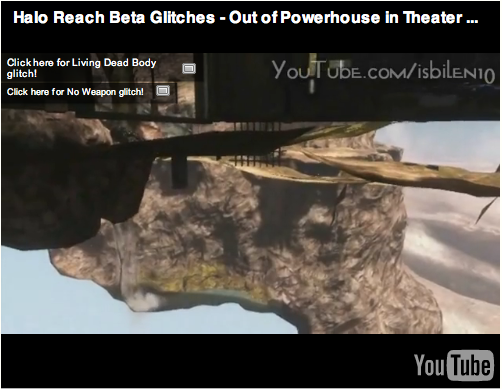
Above: Screenshot from a video demonstrating a glitch in the Halo Reach beta, described as
"falling through [the] game world." The "sky" is visible on the top left and bottom right of the screen.
Thus far, I have described the experience of the contemporary first-person shooter as idealized by gamers and game designers. Because the rhetoric of game design emphasizes the concept of 3D games, especially those in first person, as seamless simulations of reality, moments of discontinuity in these games tend to be de-emphasized. However, two common "flaws" of multiplayer gaming — glitches and lag — have become an integral part of gaming culture. These breakdowns at the gaming interface emphasize the fundamental unreality of gamespace and/or the location of the gamer in physical space.
Because first-person shooters were the first to pioneer the "full 3D space" that has become known as the most realistic and complex form of gamespace, fans of the first-person shooter genre often base their assessment of a game's quality on its ability to realistically and seamlessly simulate 3D space.17 The stakes for gamespace are also extremely high in multiplayer first-person shooter gaming. Spatial discontinuity in fast-moving multiplayer shootouts can often mean instant death for players, a fact that raises the stakes on these demands for continuity over similar demands in other genres. Gaming culture emphasizes glitches and lag partially because of gamer annoyance, and partially because gamers use these discontinuities to gain an advantage over other players.
A "glitch" is an unintentional piece of the game's code that may allow for unrealistic spatial movement within gamespace. A glitch may allow a player to walk through a wall at a certain point, for example. "Lag" may be due to hardware malfunction, as when a gamer has an out-of-date PC. However, among hard-core gamers on Xbox Live, lag is often seen as an effect of the multiplayer gaming network: differential network connection speeds at different points in physical space sometimes cause players in a multiplayer gaming environment to seem to move slowly, or discontinuously "teleport" from place to place. Julian Küchlich argues that "cheats highlight the 'topological constraints' of gamespace and the way the player negotiates them."18 However, because glitches and lag are not "cheats," but part of gamespace, these features highlight the integral discontinuity of gamespace rather than its constraints, even as gamers claim to value realistic spatial representation.
Glitches:
the thing that gives video games meaning and purpose.
use a glitch on halo to defeat any numbers or skill level of people
-- definition of “glitch,” Urban Dictionary.com
Discussing films acting as "city travelogues," Giuliana Bruno writes, "When the camera is placed at the very front of a moving vehicle…the camera becomes the vehicle: that is, becomes, in a literal sense, a spectatorial means of transportation."19 The experience of spatial movement in a first-person shooter is similar: the player is transported through the space by a virtual camera, which represents the player-character's line of sight. The player controls the sight-line/camera, which controls their character's movement in the space. Spatial glitches occur when the camera moves to a location where it would not normally be able to go, such as through a wall, to the top of a tall tower, or through the map itself. As such, it is more difficult to communicate a glitch in a first-person shooter in a still picture than it is to show the phenomenon in games with a third-person virtual camera. While pictures of spatial glitches featuring characters standing on water or in midair are relatively common, gamers usually demonstrate glitches in first-person shooters through videos. While the use of the term "camera" to refer to the view of gamespace offered on screen implies an existing space that is simply recorded, seeing this camera move through a wall or "through" the game world, showing a copy of gamespace upside-down at the bottom of the screen, reminds gamers that the "world" of the game is a real-time visual rendering of data, not a space that physically exists.
Nevertheless, online tutorials on how to use glitches to a player's advantage are routinely posted alongside "cheats" and "tips" for better performance. While glitches may initially be a source of annoyance to gamers, therefore, they are quickly absorbed into gaming culture as one of various illicit strategies gamers use to get ahead. Thus, gaming culture attempts to neutralize the disruptive potential of the glitch, incorporating glitches into a more-or-less accepted repertoire of cheating. Hard-core gamers may even use their knowledge of glitches to prove their game mastery, making glitches into a pleasurable aspect of the game space for those "in the know." Once glitches in a given map are widely known, players can either use them or avoid them at will. Lag, because of its unpredictability and ubiquity, however, is more disruptive.
Lag in Real Life: The Geographic Space of Multplayer Networks
An online gamer's worst nightmare. It's what happens when a good player gets killed more than he's supposed to, or when a bad player gets more kills than he's supposed to. Only elitist jackasses come close to the evil known as lag.
The professional player could not headshot the newcomer very well because the newcomer was lagging.
The n00b blamed the other player for lagging when he was getting slaughtered.
-- definition of "lag," Urban Dictionary.com
Travel in virtual worlds is anything but disembodied, especially when the technological apparatus fails, as in the network gaming phenomenon known as "lag." In multiplayer networks, gamers traverse virtual space at varying speeds, as game graphics advance faster or slower depending on the speed of their Internet connection, and other players seem to stand still or jerk from place to place if players' connection speeds are even the slightest bit different.
Because of its source in the structure of multiplayer networks, lag represents a genuine inequality in network connectivity that can give gamers information about other gamers' economic or geographic situation. In multiplayer shooting games, these millisecond differences in the speed of information transfer from one point to another can mean the difference between virtual life and death. Thus, on the level of the network, "real world" geographic and economic factors form the basis of game mastery in virtual multiplayer game spaces. Thus, lag does two things to hard-core gaming culture.
Firstly, lag ruptures game immersion, returning gamers to their physical body and geographic location and frustrating hard-core gamers' feeling of entitlement to an experience of game mastery. Secondly, lag demonstrates that game mastery is contingent on global technological inequalities on the level of scale, which are marked by a continuing history of Euro-American imperialism. Hard-core gamers, in an attempt to avoid lag, become increasingly aware of the geographic factors influencing differential Internet connectivity, making geographical assumptions about other gamers in multiplayer gamespace based on the behavior of the network. Meanwhile, gamers outside the US, particularly those in areas with slower Internet available, experience more lag overall, making games like Halo nearly impossible to play in some locations.
1. Lag Ruptures Game Immersion and Hard-Core Game Mastery
Billgrip Productions's YouTube video "Lag in Real Life" depicts the phenomenon of lag, transposing lag into physical space .20
Billgrip, "Lag in Real Life"
While lag can also be caused by slow hardware such as an out-of-date PC, "Lag in Real Life" attributes it entirely to the multiplayer network, with an inter-title that informs viewers, "LAG occurs in online gaming because of a slow connection." This is typical of the Xbox-centric, hard-core vision of gaming (ironically?) portrayed in the video, where a young white male gamer with a recognizable Xbox headset, chugging a Vault soft drink, furiously mashes buttons on his bright red Xbox 360 controller.
Vault, released in 2005 by the Coca-Cola company, advertises itself as "the Alpha Soda" on a promotional website that also features a bottle of Vault wearing military dog tags.21 This advertising appeal to a certain version of hypermasculinity aligns Vault closely with Xbox in both companies' open address to "the hard-core." Dyer-Witheford and de Peuter discuss Xbox's targeting of a hard-core gaming demographic, imagined as "young men who play intensively, have disposable income, adopt new hardware platforms early . . . and form opinions, through word of mouth or online, about games and machines."22 The Xbox controller, prominently featured in "Lag in Real Life," is a particularly pointed strategy for targeting hard-core gamers and leaving out others. Citing Dean Takahashi's 2002 discussion of the original Xbox, Dyer-Witheford and de Peuter write:
The most important point about the Xbox controller was simply that it was like previous controllers: players who were already virtuosos would 'get it,' and those who didn't would be as clumsy as ever—a point whose significance would not become fully apparent until . . . Nintendo's Wii challenged this assumption of familiarity. What was immediately obvious was the Xbox controller's size. It was an artifact for people with large hands, like North Americans, particularly North American men (Takahashi 2002, 160). In Japan especially, players complained vociferously. Microsoft eventually introduced the smaller Controller S, but the message had been sent: the Xbox was for big guys—hard-core subjects.23
Dyer-Witheford and de Peuter argue that the Xbox's open targeting of "hard-core subjects" led to the production and reification of a hard-core subjectivity, especially through social interactions in Xbox Live's famously hostile environment.24 Lag, however, disrupts this hard-core subjectivity by revealing that game mastery, a chief tenet of membership in the hard-core, is conditional on factors outside gamers' innate "skill," such as the speed of their Internet connection. While the Xbox controller's design was meant to maximize hard-core subjects' experience of game mastery, lag disrupts this experience, making lag one of the most annoying phenomena in hard-core gaming.
In a particularly painful demonstration of the frustration experienced by lagging gamers, "Lag in Real Life" shows a thirsty teenager reaching for a bottle of Mountain Dew sitting on a table. Whenever he gets near the bottle, he teleports back to where he started. While controlling the movement of a character in a multiplayer online game is as important to survival for an in-game character as getting a drink is to a very thirsty person, having a slow connection to the multiplayer network prevents gamers from controlling their character's movement in space. Meanwhile, the erratic movements of lagging players in multiplayer gamespace makes them difficult for other players to shoot, making lag a phenomenon that affects everyone in a gaming session, not just the person with the slow connection, who is often blamed for "lagging."
Features of the Xbox Live network such as the "Gamerscore," whereby gamers earn points across all the games they have played while connected to the network, construct Xbox Live as a meritocracy, where gamers will be matched in multiplayer gaming purely on the basis of skill. In 2005, Microsoft announced that it would include a matchmaking system named TrueSkill in all Xbox 360 consoles, so that all multiplayer matchmaking on the new system would be calculated based on a combination of the gamers' overall skill and the level of uncertainty in their skill.25 However, these assessments of gamers' "skill" are based on the assumption of perfect seamlessness in the functioning of the hardware, the software, and the network. When lagging gamers are unable to control their character, or other gamers are unable to shoot gamers who are lagging, the assumption that gamers' skill can be accurately measured through multiplayer game performance breaks down.
A quick search for "lag video games" on Google provides hundreds of websites with guides on avoiding lag, laments about the prevalence of lag, and advice about which devices create more or less lag. Strategies to avoid lag include everything from upgrading one's PC, to using a cable rather than a wireless Internet connection, to limiting the number of people within one house using the Internet at a time, to strategically connecting to gaming networks when few people in a neighborhood are online.26 The obsession with avoiding lag thus creates for some gamers an increased awareness of their physical surroundings—particularly their home Internet setup—and how those surroundings affect the speed of their Internet connection. While the doctrine of the annihilation of time and space produced by online "travel" implies that users are largely unaware of the physical factors such as cables and other Internet users in a neighborhood affecting their Internet use, gamers must make themselves particularly aware of these factors in order to avoid lag. Thus, even the process of avoiding lag disrupts the illusion of seamless gamespace and fluid online movement.
2. Lag Reveals Global Network Inequalities on the Level of Scale
Guy Collins, "Lag": "You need to move closer to the server": lag, or "latency,"
understood as a geographical phenomenon.
Guy Collins's animated short, "Lag," depicts a second version of lag in real life: the main character performs a series of actions, but experiences the result several moments later. He presses the acceleration on his car, but the car does not move. Suddenly, it leaps forward and crashes into a tree. He runs down the street, stepping on a banana peel, but slips and falls several steps later. At the doctor, he fails a reflex test, and is told he has developed "a very high latency." The solution? "You need to move closer to the server." In this understanding of lag, the slowed reaction time of the game world in relation to gamers' controller input is the result of gamers' physical distance from the multiplayer server, or from the home Internet setup of the player hosting a gaming session.
Lag underscores the fact that multiplayer network game spaces are not only virtual spaces: because they are reliant on the cables and servers that make up the Internet connections of all the gamers inhabiting them, multiplayer game spaces are physical spaces insofar as they are experienced as a network phenomenon. Thus, while gamers may appear to be competing against one another in an endlessly regenerated and re-destroyed virtual Iraqi landscape, the concept of lag as a network phenomenon reliant on physical geography makes the virtual Iraqi space less important for multiplayer gamers than the physical distance between the players using that space.
One of the factors affecting gamers' Internet connection speed is the physical distance between the gamer and the multiplayer server hosting a given gaming session, as well as the speed of Internet Service Providers (ISPs) available in their city. Speedtest.net is a website that allows users to test the speed of their Internet connection to and from various locations worldwide. A visitor to the site can click on one of hundreds of servers (represented by stars and triangles) in order to test the download speed, upload speed and "ping" (latency) between their computer and the server of their choice. Speedtest.net finishes the process by offering an estimation of how long it will take to download an mp3 file, a digital video, or a full movie from the server location selected.27
The site also offers information on the speed of Internet access measured in terms of download speed by continent, by country, and by city. According to Speedtest.net, while Europe has the fastest average download speed of all continents, the United States has the fastest in North America, and the state of Delaware has the fastest regional download speed in the US. Within the state of California, the city with the fastest download speed is Stanford, followed by La Jolla. The top ISP in Santa Barbara, CA is the University of California.28
What is particularly striking for US users of Speedtest.net is the fact that the United States is actually far from dominant in worldwide Internet connectivity. According to Ookla's Net Index, a study based on data taken from Speedtest.net, the country with the fastest download speed worldwide is South Korea (33.09 Mbps), followed by Sweden (27.64 Mbps) and eight other European countries.29 The US, with an average download speed of 10.78 Mbps, is a distant #29 on Ookla's top 100 list, "lagging" behind Asian powerhouses Japan and Taiwan, and Eastern European countries such as Ukraine, Czech Republic and Bulgaria. No US cities are represented on the top 30 world cities list for download speed, while Seoul, South Korea and Hamburg, Germany top the list. Complaints from US gamers that lag is on the rise may therefore have to do with the US's lack of dominance in Internet connectivity—a difficult fact for some hard-core gamers, whose US military-themed game narratives argue for the superiority of the US over the rest of the world, to swallow.
The sensitivity of high-speed multiplayer first-person shooting games to even the smallest variations in Internet connectivity means that lag reveals not only global, but local inequalities in Internet connectivity. Because many gamers have access to sites like Speedtest.net, or the type of information they provide, gamers complaining of lag sometimes speculate about what city a player with a particularly slow or fast Internet connection is connecting from. A gamer in Santa Barbara may lament, for example, that the Internet available in Santa Barbara is not as fast as what is available in Los Angeles. Gamers with slow connections, moreover, are often blamed for their "lagging," as if it is their fault. Rural gamers experience this form of discrimination on the Xbox Live network alongside the general hostility of the network's social environment to many forms of difference. One gamer from rural West Virginia found himself prematurely banned from Xbox Live in 2010 because he listed his location on his profile as "Fort Gay, WV," part of a general effort on the part of Xbox Live to eliminate gay-bashing from the Xbox Live network. The reported unwillingness of Xbox Live's community service to believe Fort Gay, with less than 1,000 residents, was a real place, underscores the outsider status of rural gamers in the Xbox Live network.30
While lag makes American gamers aware of the regional and national factors affecting their success or failure in the multiplayer gaming environment, gamers from countries with slower Internet connections are especially aware of lag. Lag occurs in countries with slower Internet connection speeds even if gamers play only on local gaming networks, because games' multiplayer mode is designed for fast connection speeds. A video from YouTube user KOTSHYSA shows the lag experienced by gamers attempting to play Halo in the Middle East, beginning the video by listing Internet connection speeds in different countries: "Egypt, 1M; Yemen, 512KB; Lebanon, 1M; Qatar, 1M; UAE, 8M; KSA, 256KB."31 Even for gamers with relatively fast Internet connections, the amount of lag experienced on American games by gamers in other countries often seems disproportionate to the amount of money these gamers pay for their home Internet connection. YouTube user ne0flux complains of the lag experienced "on $110/month Japanese Fiber Internet."
ne0flux, "overseas halo 3 lag"
Nick Couldry and Anna McCarthy describe these unequal "effects of scale" in our increasingly connected world:
On the one hand, executives fly across the world to meet each other, fans gather from large distances to be in the presence of a celebrity. On the other hand, those who live far from the 'nodes' (Janelle, 1991) of the global capitalist economy experience ever more intense forms of disconnection. Instead of space and place being simply reduced by modern forms of co-ordination-at-a-distance, they are made more complex. In other words, we are caught in increasingly complex entanglements of scale, acting out through the patterns of our lives what Doreen Massey (1994: 149) memorably calls "the power-geometry of time-space compression"32
These scalar effects are applicable to communication as well as travel. The "nodes" that make up the Internet are not merely abstract. They represent physical servers housed in known geographic locations. Moreover, nodes in the network are not all equally connected to each other: several "central" nodes facilitate the connection between many "peripheral" nodes. According to a 2007 Internet mapping project, 30 percent of the roughly 5,000 "peripheral" nodes would be completely disconnected without the 80 "core" nodes of the Internet.33 A 2010 circular map showing a "hyperbolic" model of the Internet, with the most heavily connected nodes at the center and less connected nodes at the periphery reveals that download speed is not the only measure of Internet dominance. Nodes located in the US and Russia stretch towards the center of the map, while few countries in Asia and Africa are even represented.
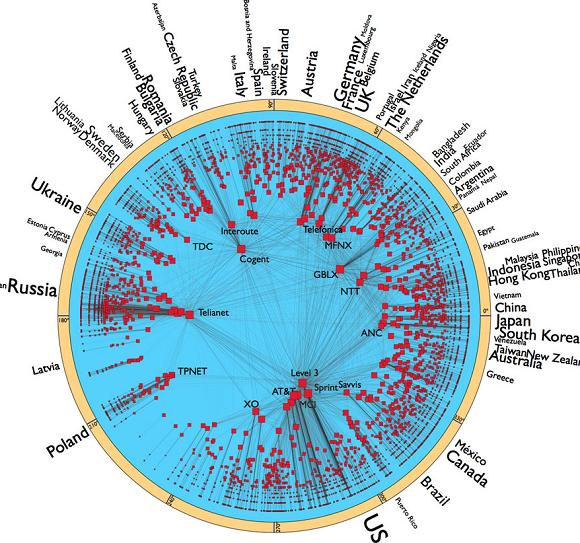
This hyperbolic Internet map produced by the University of California's Cooperative Association
for Internet Data Analysis (CAIDA) was included in Nature Communications in August, 2011.
Internet mapping projects are often motivated by the desire to make the Internet faster overall, or even to save it from ultimate collapse. Israeli scholar Shai Carmi argues that an increased use of peer-to-peer networks that connect peripheral nodes to each other could help to diminish peripheral nodes' reliance on central nodes in order to function.34 However, the University of California's Cooperative Association for Internet Data Analysis's 2010 Internet mapping project attempts to increase the speed of information transfer by streamlining the paths information would follow in the Internet's hierarchical structure.
Essentially, while information in the network may now follow one of many possible paths to reach its destination, this system of "greedy routing" would relay information in one "right direction," keeping flows of information on the hierarchical hyperbolic Internet model traveling through the Internet's central nodes.35 While the project is intended to eliminate certain parts of the Internet becoming disconnected, or falling into "black holes," this model exploits and reifies the existing hierarchical structure of the Internet that allows those closest to the central nodes to have faster Internet connections, while information for those farthest away from the central nodes must travel through more connections before reaching its destination.
Home Games at War: Soldiers Playing Video Games
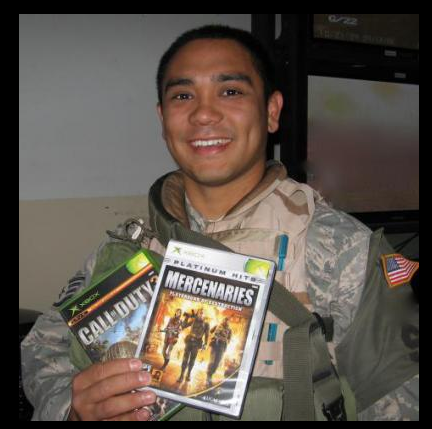
Recipients of Games for Soldiers often request the same games that top US best-seller lists. However, most deployed military personnel do not use Xbox Live, as the service is unavailable in Iraq and Afghanistan.
Image from http://www.gamesforsoldiers.com/gfs_gallery.html.
Jesse Williams, founder of Games for Soldiers, a non-profit organization that sends video games and entertainment items to U.S. soldiers deployed abroad, writes, "While it may seem counter-intuitive, if there is any group of people that can better judge the difference between real violence and game violence, it's soldiers."36 The phenomenon of soldiers deployed in Iraq and Afghanistan playing video games during their recreational time has been a topic of interest for journalists and academics not only because of video games' military recruitment potential, but because of accusations leveled against the U.S. military of "video game-like behavior" in battle situations.37 However, projects like that started by Williams posit video games, even violent ones, as firmly within soldiers' recreational time, not to be confused with the experience of war.
Williams' rhetoric of soldiers' particular ability to distinguish between the "real" experience of war and the "video game" simulation of war is particularly interesting in light of the military's increasing use of video game and simulation technology not only in the recruitment and training process, but also in the experience of "real war." While military-designed promotional games such as America's Army and Full Spectrum Warrior rely on their direct association with the military for a stamp of authenticity and realism,38 the Video Games for Soldiers project positions video games as both compatible with military service, as an effective entertainment outlet, and removed from the "realities" of combat.
This brief section about American soldiers playing video games relies heavily on the online Games for Soldiers project, and the testimony of Jesse Williams, its creator.39 A veteran himself, Williams began the project as an Army Specialist deployed in Khost, Afghanistan.40 I consider the concept of "war space" for deployed US military personnel in relation to gamespace and "home space." While gamespace is designed as a simulation of "war space" for civilians and is, with my complications above, perceived as such, soldiers deployed in Iraq and Afghanistan are experiencing the physical spaces that gamespace is designed to simulate. Therefore, their perception of gamespace is arguably different than that of gamers in the US. Even as the US military uses game-like interfaces and even training simulation games like Full Spectrum Warrior, commercial games based on war continue to be seen by soldiers abroad as nostalgic remnants of the homes they have left.
A discussion of soldiers as gamers is essential not only to understanding the relationship between military games and geography, but it is also crucial to discussing fans of military-themed games. While in many cases, fans of military-themed commercial games may not consider their gaming to be related to the actual U.S. military, the military's explicit use of video games as recruitment and training devices suggests that the skills acquired through video games are applicable to military service. In the case of remotely-controlled unmanned aerial vehicles (UAVs) such as the Predator UAV, actual flight experience may make piloting UAVs feel constricting, "like flying an airplane while looking through a straw."41 Skills needed to pilot UAVs, such as being able to understand 3D space through controlling a camera connected to a screen, could easily be acquired through playing video games, particularly those with a first-person perspective played in 3D virtual space. Because new recruits to the Army after 2002 may have learned about the military partially through their familiarity with military recruitment and training games such as America's Army (MOVES Institute, 2002) or Full Spectrum Warrior, military gaming fans in the U.S. may even be the same people as soldiers who play military-themed games.
The ongoing relationship between computer gaming and the military has become particularly interesting to scholars in the 2000s, following the success of America's Army, the ambitious military training game commissioned by the U.S. Army and designed by the Modeling, Virtual Environment and Simulation Institute (MOVES) at the Naval Postgraduate School in Monterey, California. Randy Nichols argues that America's Army was a successful response to the Army's failure to meet recruitment goals in the late 1990s, acting both as a "serious game" that taught military values to potential recruits, and an "advergame," advertising the Army to young Americans and creating online fans not only of the game, but of the military itself.42 In 2005, Nichols writes, America's Army had more than 4.6 million registered online users, and by 2007, the game had over 8.5 million users internationally.43 While these numbers do not reach the 12 million copies of Call of Duty: Modern Warfare 2 sold for Xbox 360 alone, in the mid 2000s, America's Army was successful enough that a 2005 poll found that over 30 percent of Americans age 16-34 had learned what they knew about the Army through the game.44
While America's Army may be one of the most well-known examples of the U.S. military using video games for training and recruitment, Nichols argues that the military has used many games for training purposes, even those not designed for the military. He includes in his article a 2008 list from the Department of Defense of "Video games used in U.S. military training," comprising 23 games used by the Army, Navy, Marines and Air Force, ranging from Flight Simulator (Microsoft, 1982) to Full Spectrum Warrior (USC Institute for Creative Technologies, 2004).45 The military has also acted as a "modder," modifying commercial games originally intended for civilian use only into training tools. The U.S. Army's hiring of Atari to modify its popular 3D vector game Battlezone (1980) into Bradley Trainer, used for teaching soldiers how to operate tanks, is a particularly well-known example of video games being used for military purposes.46 The U.S. Marine Corps "officially joined the mod community," however, when it modified Doom II (id Software, 1994), to create Marine Doom (1996).47
James Der Derian argues that the language and imagery used to talk about the wars in Iraq and Afghanistan is becoming increasingly game-like. He writes:
From the first to the second Gulf War, from Bosnia to Kosovo and from Afghanistan to Iraq, [so-called] virtuous war also took on the properties of a video game, with high production values, mythic narratives, easy victories and few real bodies. From the decision to deploy troops to the daily order of battle, from the highest reaches of policy-making to the lowest levels of field tactics and logistics, war games, computer simulations and command post exercises made war into a game.48
War space is game-like, according to Der Derian, chiefly because war is both mediated as a form of entertainment ("high production values, mythic narratives") and conducted at all levels of command through "war games" and "computer simulations." Even the process of searching for and defusing Improvised Explosive Devices (IEDs) in complex, urban physical spaces is aided by robots, remotely controlled via an interface that resembles a video game console. Specialized video games designed by the military are even being used for training and to treat Post-Traumatic Stress Disorder.49
Dyer-Witheford and de Peuter argue that the use of simulations throughout soldiers' war experience, from America's Army's recruitment, to Full Spectrum Warrior's training simulation to Virtual Iraq's post-traumatic stress therapy contribute to the "banalization of war."50 However, rather than arguing that video games incite gamers to violence through this banalization, Dyer-Witheford and de Peuter write, "Full Spectrum Warrior is perhaps not violent enough. The price of failure is remarkably low."51 Not only do gamers see the annihilation of their troops in short cut-scenes rather than losing each member of their squad individually, "It is also war without moral dilemmas. And there are almost no civilians . . . Air and artillery strikes do not hit wedding parties. There is no collateral damage. War is peace."52 America's Army has faced similar criticism: Nichols writes, "one of the most strident criticisms of the game . . . [is] that it indoctrinates players with 'Army values' while ignoring many critical and worrisome aspects of military life."53 Because such games are used in recruitment and training, before soldiers experience war space, and in post-traumatic stress therapy, after solders return, even military training games may be experienced as a comforting alternative to the realities of fighting in Iraq or Afghanistan.
A title that appears at the end of the campaign mode of the recent EA release Medal of Honor (2010) dedicates the story to the experiences of soldiers fighting in Afghanistan, who were interviewed heavily in the game's production process, and were represented throughout the game's narrative in a series of impossibly dangerous missions. IGN's reviewer complains that Medal of Honor's campaign mode is inconsistent in tone. He writes:
EA and Danger Close have stressed how closely they've worked with service members to ensure accuracy in the way that Rangers and Tier 1 personnel operate, and the manner in which in-game characters take down doors and move right and left while clearing rooms may be perfectly accurate. However, the action in the game frequently devolves into action movie cliches like giant explosions, hundreds of enemy combatants to kill, and scripted death sequences of American soldiers. Levels are designed more like shooting galleries than a convincing battlefield . . . Medal of Honor is so heavily dependent on canned war moments and setpieces that it starts to feel like the Theme Park tour of the war in Afghanistan, rather than a respectful trip through a day in the life of a soldier - and yeah, that weirded me out.54
While IGN finds the lack of perceived "realism" in Medal of Honor disrespectful and disturbing, the emotional intensity of Medal of Honor's gameplay that their reviewer associates with "action movie cliché" combined with the sincere dedication to US military in Afghanistan can be incredibly moving.55 Sent as a gift from well-wishers at home, a game like Medal of Honor reaches out to US military personnel not with "realism" in the sense of presenting an accurate representation of "a day in the life of a soldier," but as a combined love letter and thank-you note. The extremity of in-game situations in Medal of Honor's campaign mode asks gamers to sympathize with soldiers in Afghanistan and to support their activities there. While this message may contribute to American gamers' support for the war, US soldiers playing Medal of Honor abroad will recognize the game's lack of representational realism, seeing it more as a comforting cinematic glorification of their experiences associated with the supportive atmosphere they hope to return to at home.
Overall, game-like war devices are significantly different from games meant for civilians sent to soldiers by well-wishers. Williams writes, "A soldier in Afghanistan playing Battlefield … likely views it as … something normal from everyday life at home that s/he is partaking in… Playing a war game at home is seeking the excitement of combat. Playing a war game in a war zone is seeking the release of aggression in an otherwise dangerous environment."56 Games sent from "home" as part of projects like that run by Williams remind soldiers of experiences playing those same games or games like them with friends and family members in a domestic environment.
The nostalgic aspect of playing military games while stationed abroad recalls some descriptions of the experience of exile, though a description of American soldiers as "exiled" would be extremely problematic. Hamid Naficy argues for "a radical redefinition of what constitutes exile, from a strictly political expulsion and banishment to a more nuanced, culturally driven displacement."57 While Naficy writes about the redefinition of exile by national governments, and the disintegration of the homeland as referent, American soldiers are arguably participating in creating new exiles, as the wars in Iraq and Afghanistan have radically restructured those two countries' governments and caused immense destruction of the homelands of Iraqi and Afghan civilians. Nevertheless, in a war in which one in eight returning American soldiers suffers from Post-Traumatic Stress Disorder, American soldiers may find themselves just as unable to truly return home as their displaced Iraqi or Afghan counterparts.58 The use of video games such as Virtual Iraq to help PTSD sufferers underscores video games' crucial role in dealing with feeling disconnected from the spaces of their home.
Video games have come to represent home space over a long-term marketing strategy, similar to that deployed at the advent of TV, and the domestication of the computer, making gaming a part of the home. Andreas Lange describes how advertising campaigns for the first console gaming systems tried to link the gaming console to the television, another domesticated technology. He writes, "In typical advertisements for [Magnavox's 1972 system] Odyssey, we see a family playing while gathered around the television set in the living room… perceptions of the home video game as a toy for children rather than for adults were associated with an additional technical revolution, one that established a new location for playing: the work or hobby room."59 Because of marketing strategies dating from the 1970s, therefore, video games have become increasingly linked to home consoles and home PCs, which have been imbued by advertisers with the aura of domesticity necessary for these technologies' entry into the home.
In fact, anxiety about the "video game" aspects of contemporary war may be related to the ideologies that allowed computers to become an entertainment technology and enter the home in the first place. The MIT "Tech Model Railroad Club's" invention of one of the first recognizable video games, Spacewar!, was in the context of hijacking computers meant for, often military, research. Video games, like the Internet, have been since their inception an adaptation of military technology for civilian use. Computers, once firmly a part of "war space," were advertised as family technology meant for children so that they could be used in a domestic "home space" environment. Contemporary anxieties about violent video games, military uses of video game-like technology, and the militarization of American society may be the result of the contrast between video games' commercial image as pure entertainment and the increasing use of gaming for "serious" purposes, such as military recruitment.
Jesse Williams's discussion of soldiers as nostalgic gamers may seem like an attempt to deny the "serious" military uses of games, but it also underscores the ways in which soldiers playing video games are particularly aware of the fact that US-made military shooting games are a globally circulated commodity. While the Xbox Live matchmaking screen described above encourages U.S. gamers to see their games as representing a universal "global" commodity, American soldiers receiving games as nostalgic tokens of home are particularly aware of the American-ness of these same games. The games' pro-military themes, often criticized as potentially indoctrinating for young gamers, may actually contribute to their ability to be comforting for deployed soldiers during their leisure time.
Conclusions
This paper complicates the discussion of military-themed first-person shooting games through a discussion of geography that explores both "war games at home" and "home games at war," focusing particularly on the ways in which gamers in both positions are aware of the geographical relations implicated in their gaming. While many scholars have successfully demonstrated the connection of the campaign mode of contemporary military first-person shooters to the militarization of American society, my discussion of these war games at home focuses on the geographical and spatial implications of the multiplayer mode. Glitches, software-based malfunctions that cause unrealistic spatial movement in full 3D spaces that aim for the greatest possible degree of realism, may momentarily disrupt gameplay. However, glitches are ultimately integrated into hard-core gaming culture as new ways to prove game mastery.
Lag, discussed here as a network malfunction caused by slow Internet connections in multiplayer online gaming, is more complicated. I argue that lag unavoidably disrupts hard-core gaming culture by rupturing gamers' immersion in virtual gamespace and frustrating their feeling of entitlement to game mastery. Lag also demonstrates the geographic inequalities inherent in the hierarchical structure of the Internet.
Ultimately, lag demonstrates that military shooting games do enact inequalities between the U.S. and other countries, including those in the Middle East. However, an unintuitive but important way in which Euro-American imperialism manifests in these games is not in their visual representations of violence. Rather, the experience of multiplayer gameplay and the possibility of game mastery are unequal. Within the United States, these inequalities are subtle but perceptible, as gamers in rural areas have access to slower Internet connections than their urban counterparts. However, on a global scale, gameplay becomes even more frustrating, as U.S.-designed games become unplayable on even the fastest Internet available in Egypt, Yemen, and Lebanon. In this way, not only is the gaming experience virtual, physical and geographic, but gamers complaining of lag are in fact experiencing one of the many effects of the hierarchical structure of the Internet itself.
My discussion of the nostalgic gaming practices of US soldiers deployed in Iraq and Afghanistan complicates the concept that video games are successfully used by the US military chiefly as weapons in "war space." I also introduce the idea that military shooting games, experienced by American gamers in relation to their degree of perceived realism in portraying wartime experiences, may be in fact experienced as mementos of home by the deployed American soldiers who play the same games, making soldiers deployed abroad particularly aware of the games' position as globally circulating American commodities.
The relationship between physical space and virtual space has sometimes been discussed in terms of virtual actions "spilling over" into gamers' everyday life. However, because contemporary game consoles increasingly include the possibility of online play, gaming no longer takes place in virtual space. Rather, the space of multiplayer gaming is a physical space in that it is inextricably connected to the physicality of the Internet and the worldwide geographic inequalities of Internet connectivity. As games become more and more caught up in global communication flows, due to their reliance on the Internet and their physical circulation around the world (of which Games for Soldiers is only one small example), the questions not only of game space but of game geography will become increasingly important.
NOTES
- Nakamura, Lisa. Cybertypes: Race, Ethnicity, and Identity on the Internet. New York: Routledge, 2002. 89.
- Huzinga, John. Homo Ludens: A Study of the Play Element in Culture. Boston: Boston Beacon Press, 1955. Quoted in Katie Salen and Eric Zimmerman, "Game Design and Meaningful Play." Handbook of Computer Game Studies. Raessens, Joost and Jeffrey Goldstein, eds. Cambridge, MA: The MIT Press, 2005. 59-79, 76.
- Salen, Katie and Eric Zimmerman, "Game Design and Meaningful Play," 77; see also Suits, Bernard. Grasshopper: Games, Life and Utopia. Boston: David R.
- Godine, 1990. Bond, Paul. "'Call of Duty: Black Ops' Is Best-Selling Video Game Ever in U.S." The Hollywood Reporter. 10 March 2011, 1 April 2011 <http://www.hollywoodreporter.com/news/call-duty-black-ops-is-166625>.
- "Worldwide Fastest to 2.0 Million," VGChartz, 4 April 2011. <http://www.vgchartz.com/milestones.php>; "Americas Fastest to 1.0 Million," VGChartz, 4 April 2011. <http://www.vgchartz.com/milestones.php?reg=America&cons=>; "Call of Duty Black Ops Sales (Xbox 360)," VGChartz, 4 April 2011. <http://gamrreview.vgchartz.com/sales/44952/call-of-duty-black-ops/>.
- Halter, Ed. "Islamogaming: Looking for Videogames in the Muslim World." 1up.com, 5 Sept 2006, 1 April 2011 <http://www.1up.com/features/islamogaming>.
- Dyer-Witheford, Nick and Grieg de Peuter. Games of Empire: Global Capitalism and Video Games. Minneapolis, MN: University of Minnesota Press, 2009. 119.
- "Uncle Sam Wants Video Gamers: Playing Games Could Help Build Careers in the U.S. Military." CBS Evening News, Holguin, Jaime. CBS Broadcasting, Inc., 8 Feb 2005, 24 May 2010 <http://www.cbsnews.com/stories/2005/02/08/eveningnews/main672455.shtml>.
- Bartholl, Aram. "First Person Shooter: Everyday Counter-Strike." SpaceTime Play: Computer Games, Architecture and Urbanism, Friedrich von Borries, Steffen P. Walz, Matthias Böttger, eds. New York: Birkhäuser/Springer, 2007. 318-319, 318.
- Full Spectrum Warrioris not exactly a first-person shooting game. The viewpoint of the in-game "camera" is not that of a soldier on the ground, but rather a squad leader giving orders. The player does not directly fire weapons, as in first-person shooting games, but oversees the use of weapons. In this sense, Dyer-Witheford and de Peuter argue it might be more properly termed a "first-person thinker," a term they credit to Michael R. Macedonia. See Games of Empire, 107; Michael R. Macedonia, "A View from the Military" in Defense Horizons, 11 April 2002: 6-8.
- "Call of Duty: Black Ops Review," IGN, 9 Nov 2010, 1 April 2011 <http://xbox360.ign.com/articles/113/1133005p1.html>.
- "Mapathy.com—Download the Cure," Activision Publishing, 1 April 2011 <http://www.mapathy.com/suffer.html>.
- Baron, Dariusz Jacob. "A Short History of Digital Gamespace." SpaceTime Play: Computer Games, Architecture and Urbanism. Friedrich von Borries, Steffen P. Walz, Matthias Böttger, eds. New York: Birkhäuser/Springer, 2007. 26-31, 30.
- Graham, Stephen. "War Play: Practicing Urban Annihilation." SpaceTime Play: Computer Games, Architecture and Urbanism. Friedrich von Borries, Steffen P. Walz, Matthias Böttger, eds. New York: Birkhäuser/Springer, 2007, pp. 420-424, 423.
- Bogost, Ian. Persuasive Games: The Expressive Power of Videogames. Cambridge, MA: The MIT Press, 2007. 44.
- Bogost, Persuasive Games, 43.
- Baron, 30.
- Küchlich, Julian. "Wallhacks and Aimbots: How Cheating Changes the Perception of Gamespace." SpaceTime Play: Computer Games, Architecture and Urbanism. Friedrich von Borries, Steffen P. Walz, Matthias Böttger, eds. New York: Birkhäuser/Springer, 2007. 118-120, 118.
- Bruno, Giuliana. "Site-Seeing: The Cine City." Atlas of Emotion: Journeys in Art, Architecture and Film. New York: Versa, 2002. 15-53, 20.
- Billgrip, "Lag in Real Life," YouTube, 21 April 2009, 2 April 2011 <https://www.youtube.com/watch?v=zy6C1Gm4ALA>.
- "VAULT," The Coca-Cola Company, 2009, 2 April 2011. <http://www.drinkvault.com/index.jsp>.
- Dyer-Witheford and de Peuter, 80.
- Ibid, 81. See also Takahashi, Dean. Opening the Xbox: Inside Microsoft's Plan to Unleash an Entertainment Revolution.New York: Prima, 2002.
- Ibid, 82-84.
- Knies, Rob."TrueSkill: Matchmaking Made Easy for Xbox Live." Microsoft Research, 21 Nov 2005, 1 April 2011. <http://research.microsoft.com/en-us/news/features/trueskill.aspx>.
- Khalil, Daniel. "How to Stop Lag on Xbox Live." Helium, 15 April 2010, 11 June 2010. <http://www.helium.com/items/1805650-how-to-stop-lag-on-xboxlive>.
- These figures are especially useful for the online piracy of media texts, one of the chief reasons why Internet users might download large files from servers located across the world.
- I have used download speed data as an example for the sake of this paper, particularly because the form of lag most often depicted, in which a player tries to move his or her character but does not see that movement on screen, seems to be based on download speeds. However, ISPs differ in the equality or inequality of their upload and download speeds, and upload speed data is equally important.
- "Net Index," Ookla, 1 April 2011, 2 April 2011 <http://netindex.com/download/#>.
- Fahey, Mike."Xbox Live Gamer Suspended for Living in Fort Gay," Kotaku, 8 Sept 2010, 2 April 2011. <http://www.kotaku.com/#!5632871/xbox-live-gamer-suspended-for-living-in-fort-gay>.
- KOTSHYSA, "Halo LAG MONTAGE," YouTube, 28 Apr 2007, 2 April 2011. <https://www.youtube.com/watch?v=ufYsw2SGdWg>.
- Couldry, Nick and Anna McCarthy. "Introduction: Orientations: Mapping Media Space." MediaSpace: Place, Scale and Culture in a Media Age,Nick Couldry and Anna McCarthy, eds. New York: Routledge, 2004. 1-18, 7.
- Graham-Rowe, Duncan. "Mapping the Internet: Routing traffic through peer-to-peer networks could stave off Internet congestion, according to a new study." Technology Review, 19 June 2007, MIT, 2 April 2011. <http://www.technologyreview.com/Infotech/18944/?a=f>.
- Ibid.
- Page, Lewis."'Hyperbolic map' of the Internet will save it from COLLAPSE: Ark boffins say 'black hole' net events already common." The Register. 10 Sept 2010, 2 April 2011. <http://www.theregister.co.uk/2010/09/10/hyperbolic_map_to_save_the_net/>.
- Williams, Jesse. "Graduate student studying soldiers/video games" Email to Diana Pozo. 31 May 2010.
- McWhertor, Michael. "U.S. Army Accused of 'Video Game'-Like Behavior in Disturbing Leaked Iraq War Video." Kotaku. 5 Apr 2010. 24 May 2010. <http://www.kotaku.com/#!5510188/us-army-accused-of-video-game+like-behavior-in-disturbing-leaked-iraq-war-video>.
- See Nina B. Huntemann and Matthew Thomas Payne, "Introduction," for a description of the "Virtual Army Experience," an arcade-style video game/simulation relying particularly heavily on an appeal to realism.
- "Games For Soldiers: Morale, it's as crucial as body armor." Games for Soldiers blog. Last update 28 March 2011. 2 April 2011. <http://www.gamesforsoldiers.org/main/>.
- "About Us." Games For Soldiers. 2 April 2011. <http://www.gamesforsoldiers.org/main/?page_id=2>.
- Valdes, Robert. "How the Predator UAV Works." How Stuff Works, 18 August 2010. <http://science.howstuffworks.com/predator6.htm>.
- Nichols, Randy. "Target Acquired: America's Army and the Video Games Industry." Joystick Soldiers: The Politics of Play in Military Video Games, Nina B. Huntemann and Matthew Thomas Payne, eds. New York: Routledge, 2010. 39-52.
- Ibid, 40.
- Ibid.
- Ibid, 42.
- Bogost, Ian. "Foreward," Joystick Soldiers: The Politics of Play in Military Video Games. Nina B. Huntemann and Matthew Thomas Payne, eds. New York: Routledge, 2010, xi-xiv, xiii.
- Huntemann, Nina B. and Matthew Thomas Payne. "Introduction." Joystick Soldiers: The Politics of Play in Military Video Games. Huntemann, Nina B. and Matthew Thomas Payne, eds. New York: Routledge, 2010. 1-18, 9.
- Der Derian, James. "War/Games After 9/11." SpaceTime Play: Computer Games, Architecture and Urbanism. Friedrich von Borries, Steffen P. Walz, Matthias Böttger, eds. New York: Birkhäuser/Springer, 2007. 416-419, 418.
- See Fleming, Nic. "Virtual Iraq: Soldiers treated with video games." Telegraph. 19 Feb 2007, 24 May 2010; Jonathan Curiel, "War Games: Soldiers reenact life and death in Iraq and Afghanistan," SF Weekly, 19 May 2010, 24 May 2010.
- Dyer-Witheford and de Peuter, Games of Empire, 100.
- Ibid, 111.
- Ibid, 112-13.
- Nichols, "Target Acquired," 48.
- "Medal of Honor Review: Not-So Special Operations." IGN, 12 Oct 2010, 2 April 2011. <http://ps3.ign.com/articles/112/1127112p1.html>.
- I was almost moved to tears when I saw the final title of Medal of Honor, and I do not have relatives deployed in Afghanistan. After a night filled with motion-sickness nightmares, most likely induced by the fact that I spent the entire day before with the Xbox, the final title was both a contrasting relief from the stress of the game and a tug to the heartstrings. A gamer not so incredulous as the IGN reviewer may easily imagine that the dangers s/he has only experienced vicariously are being faced by American soldiers on a daily basis.
- Williams, "Graduate student studying soldiers/video games."
- Naficy, Hamid. "Introduction: Framing Exile." Home, Exile, Homeland: Film, Media, and the Politics of Place, ed. Hamid Naficy. New York: Routledge, 1999 1-13, 9.
- "1 in 8 Returning Soldiers Suffers from PTSD: But less than half with problems seek help, report finds," Mental health on msnbc.com, 30 June 2004, 2 April 2011. <http://www.msnbc.msn.com/id/5334479/ns/health-mental_health/>.
- Lange, Andreas. "Places to Play: What Game Settings Can Tell Us About Games." SpaceTime Play: Computer Games, Architecture and Urbanism. Friedrich von Borries, Steffen P. Walz, Matthias Böttger, eds. New York: Birkhäuser/Springer, 2007. 16-19, 18.

Author bio:
Diana Pozo is a PhD student in Film and Media Studies at the University of California at Santa Barbara. She earned a bachelor's degree in Film and Media Studies and French Literature from Swarthmore College, and an MA in Film and Media studies from UCSB. Diana has presented at international conferences on topics including the politics of revision and translation in Hergé's Tintin in the Congo, and transgender women's video blogging communities on YouTube. Her research interests include film and the nonvisual senses, animation and comic books, video game studies, feminist film theory, queer theory, and posthumanist approaches to digital media.

War Games at Home, Home Games at War: Geography and Military First-Person Shooting Games by Diana Pozo is licensed under a Creative Commons Attribution-NoDerivs 3.0 Unported License.